2026 Schedule
Space is limited, register to guarantee your spot!
Workshop descriptions below!
Schedule is subject to change. Revisit this page to see the most up-to-date schedule.
For a text version of the schedule, see here.
Workshop descriptions below!

SATURDAY CULMINATING PERFORMANCE
Co|Respondence מיט|שטימונג
Red Letter Soirée
AN IMMERSIVE, CO-CREATED SPECTACLE | SATURDAY, JULY 4th
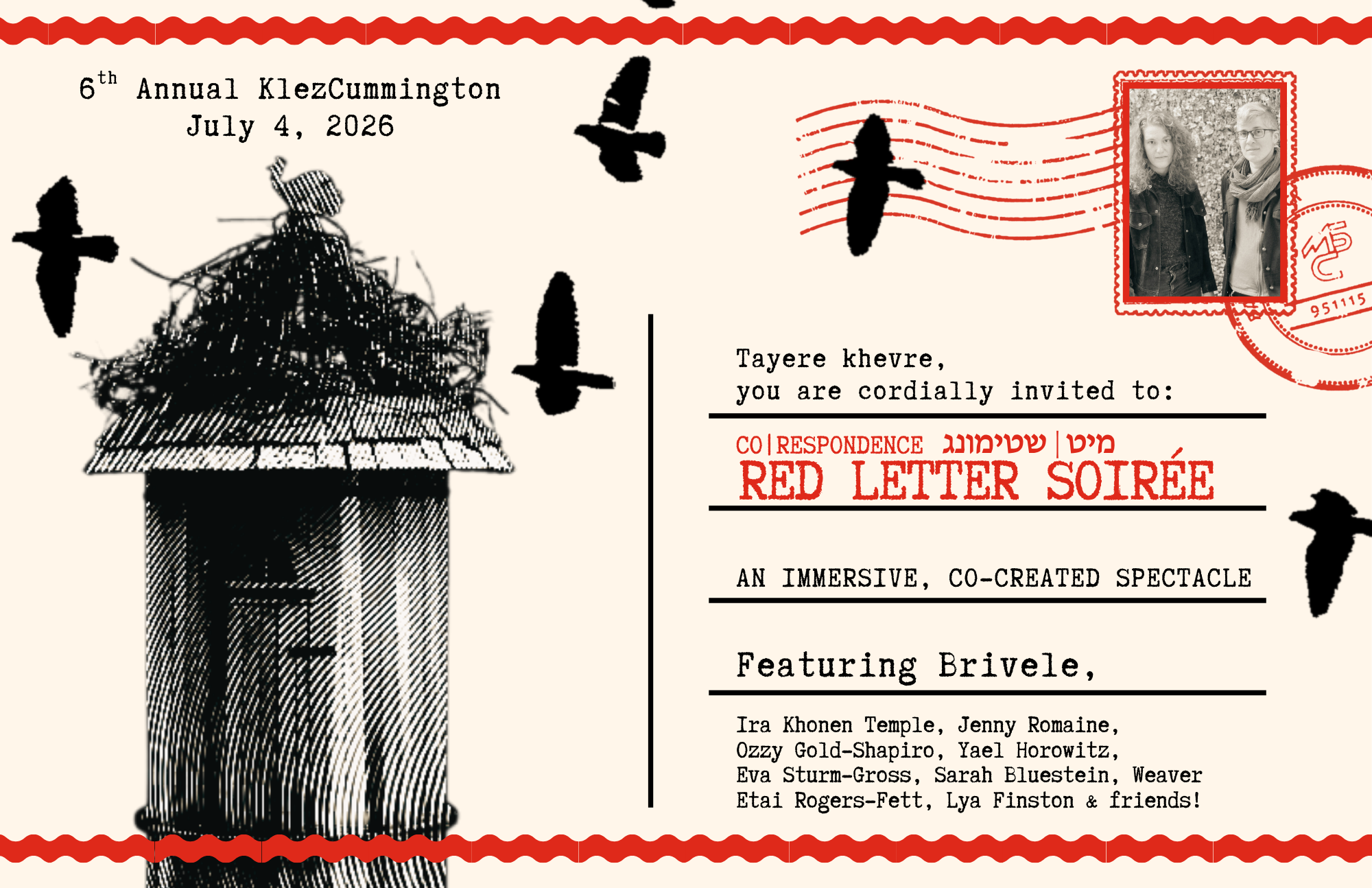
You are cordially invited to: Co|Respondence / מיט|שטימונג: A Red Letter Soirée — a culminating evening spectacle featuring a concert in the world of Brivele, theatrically staged by artist cohort Jenny Romaine, Ozzy Gold-Shapiro, Yael Horowitz, Eva Sturm-Gross, Sarah Bluestein, Etai Rogers-Fett, Lya Finston, Weaver, and others!
Inspired by Brivele’s name (meaning "little letter" in Yiddish), we will address the letter as an act of reaching – reaching across time, across borders, bridging the gap between two points, and sometimes falling short. What can letters teach us about failure and immobilization, knowing that we will not always get it right? How can we embrace the risk of embarking on the impossible, even and especially when the stakes are so high? Together, and only together, let us gather and seal this commitment to reaching, failing, and trying again.
Plug in! There will be opportunities throughout the festival to participate in staging this performance – writing letters, printing decorations and banners, making lanterns, and more – all of which will come together for the Red Letter Soirée on the evening of Saturday, July 4th!
Workshop Descriptions
-
Cookie Segelstein is a founding member of Veretski Pass: Taking its name from the mountain pass through which Magyar tribes crossed into the Carpathian basin to settle what later became the Austro-Hungarian Empire, Veretski Pass offers a unique and exciting combination of virtuosic musicianship and raw energy that has excited concertgoers across the world. Veretski Pass plays Old Country Music with origins in the Ottoman Empire, once fabled as the borderlands of the East and the West. In a true collage of Carpathian, Jewish, Rumanian and Ottoman styles, typical suites contain dances from Moldavia and Bessarabia; Jewish melodies from Poland and Rumania; Hutzul wedding music from Carpathian-Ruthenia; and haunting Rebetic aires from Smyrna, seamlessly integrated with original compositions. Their CDs have repeatedly been on the 10-best recording lists of journalists since 2002.
-
Plug! At the Red Letter Salon, an ongoing workshop station, there will be opportunities to participate in staging this performance – writing letters, printing decorations and banners, making lanterns, and more – all of which will come together for the Red Letter Soirée on the evening of Saturday, July 4th!
-
In this workshop we will listen to some source recordings from the klezmer and Transylvanian canons, compare and contrast them, and learn some tunes from both traditions which show similarities.
-
Through a stirring blend of storytelling and music, Brivele presents an intimate lecture-performance exploring the Yiddish archives of anti-fascist poetry and song. This presentation highlights the transformation of two songs from the 1930s, "Di Moorsoldaten" and "Di Krenetse." The diasporas of these songs, traveling over borders and into different languages, helps us trace so many intersecting lineages from German anti-fascist and labor history to the internationalist struggle against Franco, to the conveniently forgotten intimacy between Immigrant radicalism, Communist avant-garde artists, folkies, Yiddishists, and Black liberation politics on Turtle Island. Initially researched for Maia Brown’s 2024 artist residency at Town Hall Seattle, these stories continue to evolve as research findings reveal new connections.
-
If you pass a tree at the festival and hear something unexpected, put your ear to the trunk and listen closely. You may hear the voice of a Yiddish grandmother, a bobe in der boym.
Chaia has collected recordings of legendary folksingers Lifshe Schaechter-Widman and Feigl Yudin, poet Malka Lee, and her own grandmother, Daisy Dreisl Blima Berman. Listen to these grandmothers as they reflect on Yiddish, life, and heritage and share secrets only bobes know. If you’re lucky, you might hear them call to each other across the trees, entering into conversations that defy time and space.
-
Join artists Lya Finston and Etai Rogers-Fett for a workshop on cyanotype — an early photographic process also known as sun-printing. Artist-in-Residence Lya Finston’s installation at this year’s festival includes many cyanotypes on fabric, for which she used her body, plant material, and large-scale negatives as light-blocking stencils. In this workshop, you’ll have the chance to learn more about Lya’s cyanotypes and make your own!
Throughout the making process, we’ll ask ourselves:
How can we use our bodies, cut-stencils, light, and elements of the land around us to tell stories about human connection and correspondence? In what ways is making photographic images with the sun a way of sending and receiving messages?
-
You’re invited to join us for the in-person premiere of Brivele’s new music video, created by Yiddishist and puppetry artist Yankl Krakovsky. Released on June 27 in honor of the Industrial Workers of the World (IWW) 121st anniversary, the video accompanies Brivele’s bilingual rendition of the beloved labor ballad “I Dreamed I Saw Joe Hill Last Night” (with Yiddish lyrics by Michael Wex). Drawing from archival sources including Joe Hill’s own paintings and documentations of his arrest and execution, the video employs paper puppetry and stark black, white and red visuals to bring this fantastic recording to life and honor the memory of the song’s titular labor martyr.
-
Now that we've gotten the Bund onto the best-seller list, it's high time to sing some more anthems together! An anthem is what we sing when we are committed to having mass movements, and also sometimes when we are sad and want to believe in a better future. Let's be together and sing!
Led by Ira Khonen Temple, a multi-instrumentalist, music director, and embedded cultural organizer living in Brooklyn, NY.
-
This hands-on reading/discussion/creating workshop will introduce the antifascist queer Jewish poetics of the midcentury American poet Muriel Rukeyser. We will look at how Rukeyser used archival sources to construct her own poetry and then use selected materials from Rukeyser's own archive, including her extensive FBI file, to play with and construct our own poems/collages.
-
Jordan Wax is a multi-instrumentalist, singer, and composer based in New Mexico. For the past twenty-five years he has studied intergenerational music traditions with elders from a variety of cultural lineages in the Ozarks, Mexico, Ecuador, New Mexico, and throughout Yiddishland, and directed collaborative ensembles in the context of Ashkenazi, Ozark, and Indo-Hispanic cultural revitalizations. He began his formal study of Yiddish with Peysakh Fiszman in 2000, and since has worked with Perl Teitelbaum and informally with elders who have shared with him the warmth and complexity of Yiddish’s musical and spoken dialects. In addition to ongoing projects with poly-ethnic traditions in New Mexico, his current work centers his songwriting in Yiddish. His debut album, טײַטש | The Heart Deciphers was released in January 2025 by Borscht Beat, and was followed by פּאַנטאַקאָזאַק | Pantakozak, a collection of original Yiddish/English songs for children and families.
-
Raffi Boden & Daniel Kunda Thagard’s new duo features the cello and tsimbl as unique voices, drawing new textures from old material. The two build a raw, trance-like soundscape out of the slow and soulful heart of klezmer music, reveling in the tunes traditionally played at dawn and twilight.
-
Zayt bagrist! Welcome to KlezCummington! Stop by the welcome table at any point in the morning to make a Yiddish nametag and get to know new folks. Materials and guidance on alef-beys will be provided. Open to all levels of Yiddish language knowledge!
-
Come learn about the communist Yiddish chicken farmers in Petaluma California and the artist book that Etai and Yael collaboratively made about them! This workshop will feature a reading of the book, a short presentation about its creation process, and a discussion about collaborative storytelling with historical narratives.
-
Join Ozzy and Ben for a hands-on exploration of Ashkenazi Jewish food history! We’ll be exploring the ways in which diaspora, halakha, borders, neighbors, and immigration shape what appears on the table. Come ready to shape bagels, chop, salt, pickle, and brine! The food we make will be served as part of the bagel deli lunch!
-
All ages, levels, and instruments welcome! This jam will be an accessible jam geared towards klezmer beginners, but anyone is welcome. Tunes will be played slowly, and sheet music/charts will be provided. Bring a tune to play and share, or come to learn!
-
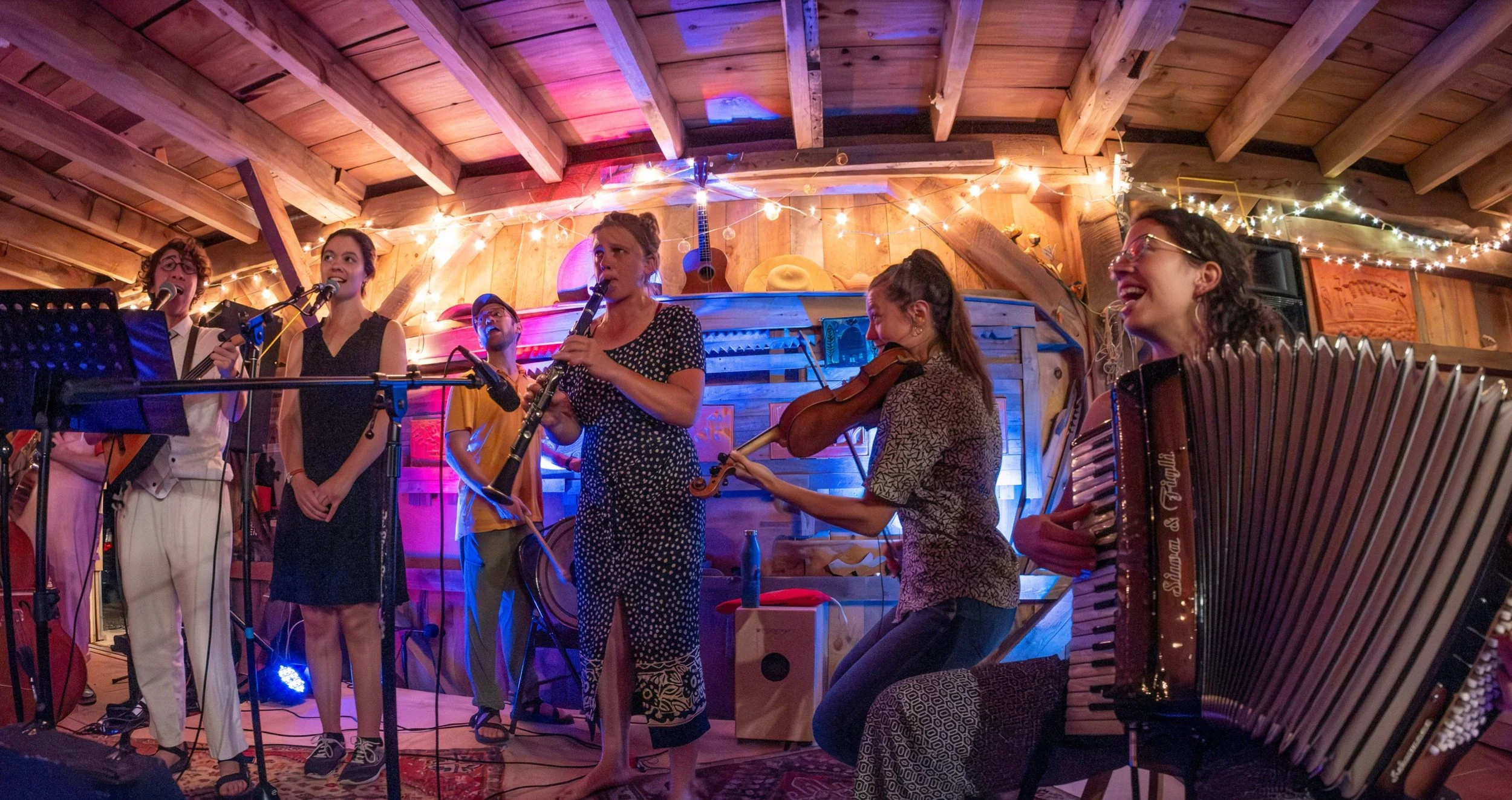
A Glezele Tey (Yiddish for “a little glass of tea”) invites you into their living room for a little glass of tea from the samovar, bringing audiences into an intimate and enthralling world of klezmer, Yiddish folk song, and tkhines (traditional Ashkenazi prayers centering the experiences of women, trans, and gender non-conforming people, set to new melodies). Drawing from old recordings and contemporary culture rooted in the Eastern European Jewish diaspora, A Glezele Tey’s music is an act of deep care—rooted in community gathering, lineage, and ritual, we lift our collective voices to move through grief, inspire action, and build a frayer velt (a freer world).
-
In this dance workshop we will engage in a deep, focused study of the zhok. We will see what happens when we pay attention to different pieces of the dance.
-
Dance Party! Using Jewish and co-territorial tunes, Cookie will show you to play the music in a way that makes the dancers want to lift their feet, how to handle the rhythmic connections between phrases, and dance band tips and tricks.
-
Lya Finston: My artistic practice is an investigation of worry, and the ways in which religion and perception construct themselves around it. My reflections on Jewish folk culture legitimize superstition, holding it sacred for the cultural legacy and promises of safety it provides. Here we find less intellectualized, and more inherited frameworks for understanding the world, whose very unprovability lend them validity. These traditions speak volumes to the human experience, illuminating the regional and historical circumstances from which they were born, and mirroring timeless anxieties of humankind. My prints and sculptures exist within a blended domestic-spiritual landscape. By enlisting the inherent authority of the graphic mark, I am able to bolster so-called superstitions, reifying my depictions of them in a visual language that is at once historical and contemporary.
I am a Jewish artist who is interested in investigating, bolstering, and celebrating the diasporic, anti-zionist Jewish culture with which I identify. Traditions that are categorized as "superstition" are of particular interest to me because they so often blend into the landscape of the home, encompassing the experiences of women and other marginalized groups within traditional Jewish practice. I am commited to engaging with Jewish traditions in the direction of universal emancipation for all people. -
Lomir shmuesn — let’s chat! This beginner-friendly shmueskrayz (“conversation circle”) is an opportunity to practice your conversational Yiddish in a friendly, moderated environment. We’ll practice some conversational basics that will help you enjoy more of your KlezCummington <af mame-loshn>. Yiddish-speaking experience not required (but it couldn’t hurt!) Facilitated by Magde Safer and Yankl Krakovsky.
-
The residents of Burin, Palestine have invited people around the world to fly kites alongside them in their own communities as part of a global campaign demanding the end of military closure, land seizure, and occupation. Come fly kites with us and show solidarity with the community of Burin! Bring your own kite if you have one! We will also provide materials for those who would like to make and/or decorate a kite. And please consider donating here to the Burin kite festival, to help fund transportation, kite materials, and activities for kids in Burin!
-
Is culture work a serious form of organizing? What’s so Yiddish about op-sec? How has Yiddish culture been a beacon of anti-state and anti-repressive existence throughout history? Can it still be? Come and hear lessons and ideas for organizing and culture work ranging from the intuitive to the unintuitive to the practical and strange learned during Operation Metro Surge about how cultural autonomy can keep your community safe.
-
With Pantakozak, Jordan Wax has created a secular Yiddish children’s music album with the same level of care and attention as the best albums for adults, blending joy (nakhes), play, and a deep regard for cultural heritage. Wax draws on klezmer, Lăutari, and American musical traditions to build an artistically and musically rich collection of songs, rejecting the simplistic, sing-song approach that much of today’s children’s music takes, and creating an experience enjoyable for both kids and adults.
Pantakozak brings together intergenerational material from a variety of sources, including songs from oral histories with elders, pieces co-composed by preschoolers, and performance-oriented “kids literature” songs, all of which engage children in exploring language, resilience, and identity through the lens of a uniquely Yiddish playfulness.
This is an album for all families with young children, from Yiddishists to non-Jews, spanning themes from soccer, monsters, and polar bears to Jewish holidays and traditions.
-
Brivele is a Seattle-based ensemble who braid together Yiddish song, anti-fascist and labor balladry, folk-punk, and contemporary rabble-rousing in stirring vocal harmony. In Yiddish, Brivele (בריוועלע) means "little letter." Like letters, songs travel — through time and over borders. They pick up dirt, aromas, fingerprints. They are sent to lovers, they foment revolution, they get stolen and censored, burned and salvaged, sewn into our clothes.
We journey into the archives of Yiddish anti-fascist musical tradition, bringing together anti-authoritarian satire, mournful remembrances, and the disguised political commentary in folk ditties and theater classics. These songs are a correspondence: our ancestors' voices speak clearly and uncompromisingly, sometimes sweetly, to our present moment.
-
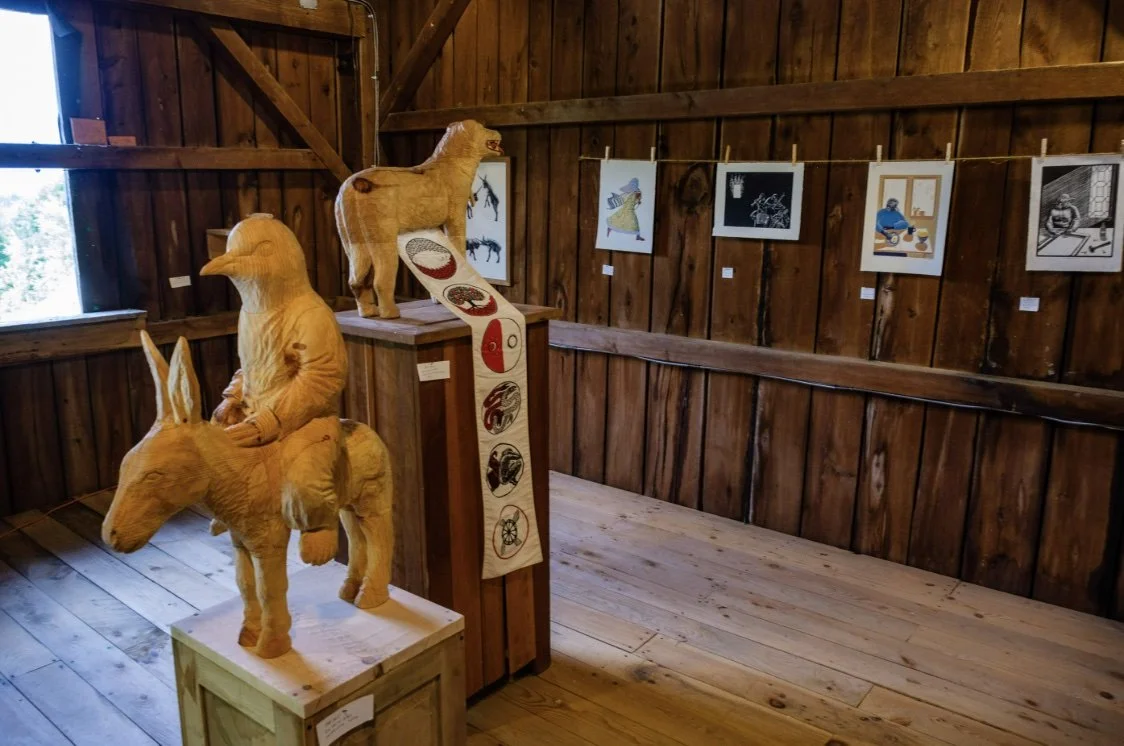
Emmett Leader’s “Slonim Revisited” is an installation that is a window into the world of Judaism and the Jewish Diaspora. It weaves two stories, one dealing with his youth in rural Vermont, and the other based upon the pre-World War II Eastern European Jewish shtetls of his grandparents and their ancestors. This installation is a visual feast made up of a wooden shelter with earthenware panels on the walls, a large pair of doors, clay ritual objects on wall pedestals and various clay and found items on mantles. The artwork uses a folk, vernacular style and the overall effect is of a barn shrine; a holy space within a rural setting.